
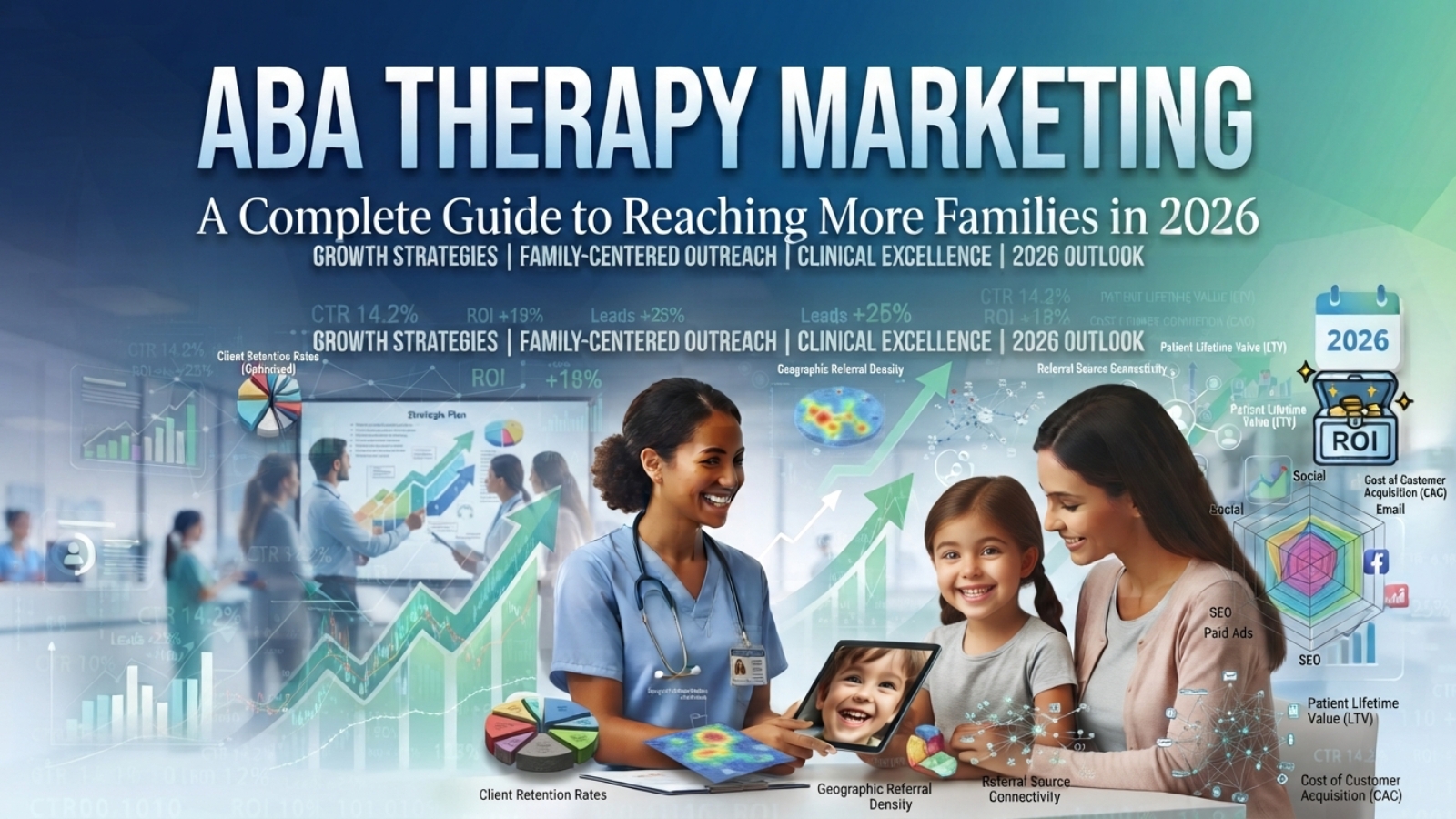
Families searching for applied behavior analysis services are not browsing casually. They are often navigating a recent autism diagnosis, researching insurance coverage, and trying to determine which provider will be the right fit for their child, sometimes on a tight timeline set by a waitlist or an insurance authorization deadline. That combination of urgency, emotion, and careful research is exactly why ABA therapy marketing looks different from promotion in almost any other field, healthcare included.
This guide covers what a strong outreach strategy for applied behavior analysis providers actually involves, why generic advertising approaches tend to fail this audience, and how ABA organizations can build a plan that earns trust with parents and caregivers while growing enrollment sustainably.
What Is ABA Therapy Marketing?
It is the set of strategies applied behavior analysis providers use to reach, educate, and convert the parents and caregivers who are researching services for their child. It includes search engine optimization, paid advertising, website design, content and parent education, and reputation management, all shaped around the specific needs of this audience: clear explanations of services, visible credentials, and messaging that speaks to parents rather than at them.
Because ABA therapy organizations are healthcare providers, the same compliance standards that apply to medical marketing broadly, including HIPAA and truthful-advertising requirements, apply here as well. But the audience behavior is distinct enough that a generic healthcare marketing approach, without ABA-specific adjustments, tends to underperform.
At Diamond Medical Marketing, applied behavior analysis organizations are one of our primary areas of focus. We understand both the compliance side of this work and the parent-focused messaging that determines whether a family picks up the phone.
Why Families Search Differently for ABA Services
Understanding how parents and caregivers actually search is the foundation of any effective plan in this space.
The search often starts with a diagnosis, not a service name. Many parents begin searching right after a pediatrician or developmental specialist raises the possibility of autism, before they fully understand what applied behavior analysis even is. Content that explains services in plain language, without clinical jargon, performs better with this audience than technical service pages built for other providers.
Insurance coverage is a major decision factor. Parents frequently search alongside terms related to their insurance plan, since ABA services can be costly and coverage varies significantly by state and payer. A strategy that clearly addresses insurance acceptance and the authorization process removes a major point of friction.
Waitlists shape urgency. Because many established ABA providers have long waitlists, families often search for multiple providers at once and choose based on who responds fastest and most clearly, not just clinical reputation alone.
Trust signals matter enormously. Parents are placing their child’s care and progress in a provider’s hands. Credentials (BCBA-certified staff, license verification), clear descriptions of therapy approaches, and honest, permission-cleared testimonials carry significant weight in this decision.
Referral sources shape the first impression before a search even begins. A pediatrician, a school psychologist, or another parent often names a provider before a family opens a search engine, which means the website and online presence need to confirm, not contradict, whatever reputation preceded that first click. A provider that looks outdated, unclear about services, or difficult to reach online can lose a referral that a colleague or friend worked hard to send their way.
Core Components of a Strong ABA Therapy Marketing Strategy
Local and Specialty-Specific SEO
Search visibility is often the first and most important channel for reaching new families, since most parents begin their search on Google rather than social media. Effective SEO for ABA providers includes location-specific service pages, content that answers common parent questions, and technical optimization that helps a website rank for both the diagnosis-stage searches (“what is ABA therapy”) and provider-stage searches (“ABA therapy near me”).
A Website That Speaks to Parents, Not Clinicians
An ABA provider’s website is often the deciding factor in whether a family calls. It needs plain-language explanations of services, clear information about age ranges served and insurance accepted, staff credentials, and a straightforward way to request an intake consultation. Complicated clinical language or a difficult-to-navigate site can cause a parent to leave for a competitor.
Compliant, Sensitive Advertising
Paid campaigns for ABA services require particular care. Ads cannot use protected health information for targeting, and creative has to be written with sensitivity toward families who may be processing a recent diagnosis. Done well, advertising can put a provider in front of parents at the exact moment they are searching, without exploiting their circumstances.
Parent Education Content
Blog posts and guides that answer real questions, such as what an initial ABA assessment involves, how insurance authorization works, or what progress typically looks like in the first few months, build both search visibility and trust. This kind of content positions a provider as a knowledgeable resource before a family ever makes contact.
Reputation and Referral Management
Reviews and word-of-mouth referrals carry significant weight in this field, since parents often ask other parents, pediatricians, and school staff for recommendations. Ethical review-generation and responsive reputation management help a provider build the kind of visible trust that drives new enrollment.
Combining Channels for a Complete ABA Therapy Marketing Plan
No single channel carries the full weight of a family’s decision. The strongest ABA therapy marketing plans combine SEO, a parent-friendly website, compliant advertising, education content, and reputation management so that a family encounters consistent, trustworthy information at every touchpoint, whether they find a provider through a Google search, a pediatrician referral, or a school recommendation. Treating these channels as separate, disconnected tactics is one of the most common reasons an otherwise reasonable marketing budget underperforms.
For multi-location ABA organizations, this coordination becomes even more important. Each location typically has its own waitlist, staffing, and service area, which means ABA therapy marketing has to be localized rather than run as a single, generic campaign across every site. A location-specific approach to SEO, advertising, and even content keeps messaging relevant to the families searching in each community the organization serves.
Compliance Considerations Specific to ABA Providers
Because ABA therapy organizations are healthcare providers, marketing has to follow the same core compliance principles that apply across the medical field, with a few considerations specific to this population:
- Avoid using protected health information (PHI) in advertising, retargeting, or testimonials without a signed release.
- Be careful with claims about outcomes. Progress in ABA therapy varies significantly by child, and marketing should avoid language that promises specific results.
- Handle testimonials involving children with extra care, using signed HIPAA releases and anonymization where appropriate.
- Follow state-specific licensing and advertising requirements, since ABA regulation varies by state.
- Review messaging for sensitivity, since this audience is often navigating a difficult and emotional period.
A responsible partner treats these considerations as part of ABA therapy marketing from day one, not as a legal afterthought applied after creative is already built.
How to Measure Results for an ABA Provider
The right performance indicators for an ABA organization look somewhat different from a general medical practice, given the enrollment-based nature of the business:
- Qualified intake inquiries, tracked by source, not just total website visits.
- Intake-to-enrollment conversion rate, since not every inquiry becomes an active client.
- Search visibility for both diagnosis-stage and provider-stage keywords.
- Referral source tracking, since pediatricians, schools, and existing parents are often major contributors to new enrollment.
Results vary based on location, waitlist capacity, and competition, and no responsible ABA therapy marketing partner should guarantee a specific enrollment number. What matters is a transparent, ongoing view of where inquiries are coming from and how efficiently they convert.
Common Mistakes ABA Organizations Make in Their Marketing
- Using clinical language on the website that a parent unfamiliar with ABA terminology cannot easily follow.
- Not addressing insurance clearly, leaving a major decision factor unanswered until a phone call.
- Treating all locations the same in SEO and content, rather than building location-specific pages for each service area.
- Ignoring referral relationships with pediatricians and schools as a marketing channel.
- Skipping compliance review on testimonials or outcome-related claims.
Addressing these gaps in ABA therapy marketing is often what separates an ABA provider with a full caseload from one struggling to fill open slots.
Why Diamond Medical Marketing Focuses on ABA Therapy Organizations
Applied behavior analysis is a named area of focus for our ABA therapy marketing team, not a secondary service offering. We build strategies that combine healthcare-grade compliance with messaging written specifically for parents and caregivers navigating a diagnosis and a provider search. Services include specialty-specific SEO, website design built for this audience, compliant paid advertising, parent education content, and reputation management, delivered through Silver, Gold, and Platinum service tiers sized to the size of the organization, from a single-location practice to a multi-site provider.
Reported outcomes across our healthcare client base range from a 20 to 50 percent increase in qualified inquiries, varying by specialty and starting point, supported by a client retention rate above 90 percent.
Frequently Asked Questions
How is ABA therapy marketing different from general healthcare marketing?
It requires messaging written specifically for parents and caregivers, often at an emotional and information-gathering stage shortly after a diagnosis, along with attention to insurance coverage and waitlist dynamics that are less central in other specialties.
How long does it take to see results?
SEO for ABA providers typically takes three to six months to build meaningful visibility, while paid advertising can generate inquiries within thirty to sixty days. Timelines depend on local competition and existing online presence.
Can testimonials from parents be used in marketing?
Yes, with a signed release and appropriate care around any information that could identify the child or reveal protected health information.
Does ABA therapy marketing need to address insurance directly?
Yes. Since insurance coverage is one of the biggest factors in a family’s decision, addressing it clearly on the website and in content removes a significant barrier to inquiry.
Is paid advertising appropriate for reaching families of children with autism?
Yes, when it is built with sensitivity and compliance in mind. Advertising can put a provider in front of parents at the right moment, as long as targeting avoids protected health information and messaging respects the audience’s circumstances.
Should an ABA organization prioritize SEO or paid advertising first?
Most organizations benefit from starting both channels in parallel: SEO builds durable, long-term organic visibility that compounds steadily over many months, while paid advertising can generate inquiries more immediately while that organic visibility is still being built out. The right balance ultimately depends on current waitlist capacity, service area competition, and available budget.
Final Thoughts
ABA therapy marketing succeeds when it treats parents and caregivers as people navigating a significant decision, not as leads to be converted quickly. A strategy built around plain-language education, clear insurance information, credential visibility, and compliant execution earns the kind of trust that drives enrollment, while a generic approach borrowed from other industries tends to fall flat with this audience.
Diamond Medical Marketing works with ABA therapy organizations nationwide to build compliant, parent-focused strategies across SEO, website design, advertising, and reputation management. To talk through what a tailored plan could look like for your organization, schedule a free demo with our team.
About the author: This guide was prepared by the Diamond Medical Marketing team, an agency with applied behavior analysis as a named area of focus, working alongside healthcare providers nationwide with direct experience owning and licensing healthcare businesses.
This article is for general informational purposes and does not constitute legal or compliance advice. ABA organizations should confirm that their marketing materials meet all applicable state and federal requirements.
Add a Comment